
The Investing Infanteer: Arming RMR Soldiers with Financial Readiness
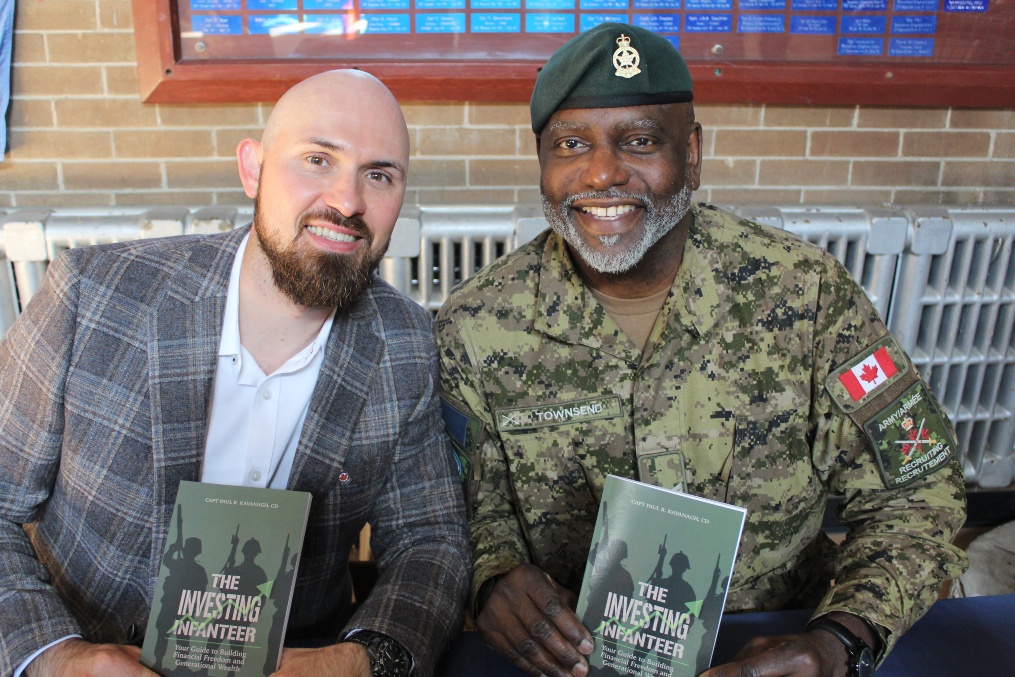
Westmount, Quebec – 02 September 2026: Soldiers of The Royal Montreal Regiment (RMR) received something a little different from the usual military issue this weekend: a book about money.
Copies of The Investing Infanteer, written by Paul Roan Kavanagh, CD, currently serving as the RMR Adjutant, were distributed to soldiers as part of an initiative aimed at improving financial literacy within the Regiment.
The idea behind the book is straightforward. Soldiers spend years learning how to operate weapons, lead teams, plan operations and perform under pressure, yet many receive relatively little instruction on managing one of the things that will affect virtually every stage of their adult lives: their finances.
Kavanagh began trying to address that gap six years ago.
When he started writing in 2020, he was a newly appointed Platoon Commander with India Company, 2nd Battalion, The Royal Canadian Regiment. He does not present himself as a professional financial adviser. Rather, he describes himself as someone who had developed an interest in finance through years of reading, listening and learning from the successes and failures of others. His original intent was considerably more modest than producing a book. He created a simple one-page guide introducing his young soldiers to the basics of personal finance and investing.
What he saw among those soldiers convinced him there was a larger need.
Many were entering the military, university or adult life with little exposure to fundamental concepts such as investing, saving and financial discipline. Kavanagh also came to recognize that the problem was hardly limited to those without a university education. Financial literacy, he observed, was a challenge for people from many different backgrounds.
The one-page handout consequently kept growing. New subjects were added. Those became sections, sections became chapters, and eventually what had begun as informal advice for a platoon developed into The Investing Infanteer. Kavanagh’s objective remained the same throughout: produce something a soldier could actually read, understand and apply without already possessing a background in finance.
That military perspective is deliberately built into the book.
Kavanagh describes the finished product as having a distinctly military flavour, inspired by the soldiers, sailors and aviators with whom he has served. Even the title reflects that connection. The traditional term “Rifleman” was reworked as “Infanteer”, placing the book firmly within the culture from which the project emerged.
At its core, however, the subject is not complicated investment theory. Kavanagh’s stated purpose is to offer readers simple concepts in personal finance and investing, providing a foundation from which they can continue learning. He argues that financial stability depends not simply on earning money, but on understanding what to do with it and developing the discipline to make informed decisions over time.
That message has particular relevance to young soldiers.
For many members of the RMR, joining the Regiment coincides with other major transitions: beginning post-secondary education, starting a civilian career, living independently for the first time, receiving a steady paycheque or beginning to think seriously about longer-term goals. Financial decisions made during those years can compound, positively or negatively, for decades.
There is also something recognizably military in the philosophy behind the book. Preparation matters. Small decisions accumulate. Discipline matters more than short bursts of enthusiasm. Understanding the fundamentals before they are urgently required usually produces better results than trying to learn them during a crisis.
In June, Kavanagh formally approached the RMR Foundation with a proposal to acquire 200 copies of The Investing Infanteer so they could be distributed at the regimental level. In presenting the project, he described his aim as bringing greater financial stability and clarity to serving members and potentially, in time, to the wider military and veteran community.
The distribution of the book to RMR soldiers this August therefore represents the culmination of a project that began not as a commercial concept, but as one junior officer trying to give his platoon useful information.
Six years later, that one-page handout has become a book in the hands of soldiers across the Regiment.
For Kavanagh, the ambition extends beyond teaching people how to invest. It is about giving military members another tool with which to prepare for their future.
And for the RMR, it is a reminder that developing soldiers does not stop when the training night ends.
